Pros
- Connects compatible legacy RS232 equipment to an RS485 bus
- Passive operation avoids a separate power adapter per manufacturer listing
- Model-specific rate, distance and interface details are published

All categories
 New condition
Computer Accessories
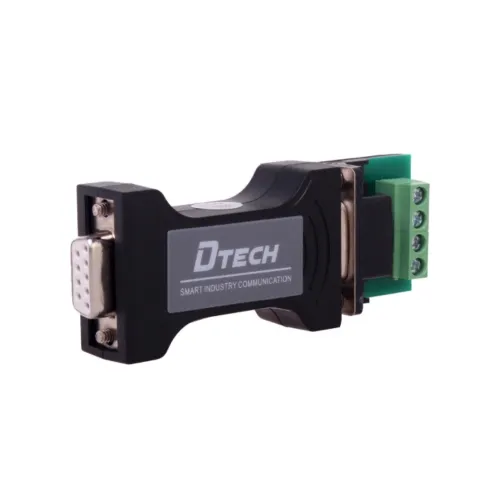
Dtech · DT-9000 Passive RS232 to RS485 Converter
Dtech DT-9000 passively converts RS232 and RS485 serial signals; catalog rate is 300–38,400bps and 1.2km at 9,600bps. Verify wiring and revision.
Approximate Market Price
BDT 550
Informational market estimate only; this is not a current Store offer.
Compare store prices
No live offers for this variant
BDT 550
Approximate Market Price
Informational market estimate only; this is not a current Store offer.
Loading history…
Product story
The Dtech DT-9000 is a passive serial interface converter intended to connect compatible RS232 equipment with an RS485 bus. Dtech’s DT-9000 catalog lists a communication rate of 300–38,400bps, a maximum distance of 1.2km at 9,600bps and up to 32 connected RS232/RS485 devices. The manufacturer describes automatic send/receive operation without external traffic-control signals. These figures depend on wiring, topology, signal quality and connected equipment; configure both ends consistently and verify the exact model revision and terminal wiring before deployment.
The manufacturer lists an RS232 DB9 female interface and a four-position RS485 terminal block. RS232 is generally used for a point-to-point device connection, while RS485 supports a differential bus. Identify signal A/B, ground/reference and device pin labels from the product documentation; terminal labeling conventions can differ between manufacturers. Do not assume that an A terminal always maps to another vendor’s A terminal without checking polarity documentation. Incorrect wiring can prevent communication or risk equipment damage.
The DT-9000 is described as passive and automatically handles transmit/receive direction without an external flow-control signal. Manufacturer materials describe a charge-pump style circuit that obtains operating power from RS232 signaling, so no separate power supply is indicated for the standard model. A passive converter still depends on the electrical conditions and signal lines of the connected equipment. Confirm that the specific RS232 device provides the required signals and that the product is the passive DT-9000 rather than another powered or isolated converter model.
The model-specific DT-9000 brochure lists 300–38,400bps and 1.2km at 9,600bps. A separate DTECH product page lists a higher rate up to 115.2kbps and a distance of under 1,200m RS485 / within 15m RS232; this conflicts with the DT-9000 brochure rate. The product copy follows the DT-9000 catalog value and records the inconsistency rather than promising 115.2kbps. Maximum distance and rate should not be assumed simultaneously; actual achievable performance depends on cable, topology, noise, termination, device loading and baud rate.
Dtech specifies asynchronous half-duplex operation on the RS485 side and automatic send/receive without external traffic control. Half-duplex means devices share the bus and transmit in turn; it is not a full-duplex point-to-point link. Configure baud rate, parity, data bits and stop bits consistently across communicating devices. The converter does not translate application protocols such as Modbus or change message formats; it adapts the electrical interface while host software remains responsible for protocol and device addressing.
Dtech lists up to 32 connected RS232 or RS485 devices. RS485 network design, node loading, termination, biasing, wiring branches and device roles affect the practical node count and reliability. Do not interpret “32 devices” as a guarantee for every topology or as permission to connect multiple RS232 hosts arbitrarily. Follow the equipment manuals and use a correctly designed bus, with termination at appropriate ends when required. The converter is not a multiport serial server.
Dtech’s product page describes optical and electrical isolation rated 2.5kVrms/500VDC insulation and 600W per-line lightning protection. These are manufacturer claims for the listed model; installation conditions and surge type affect real protection. They do not replace proper grounding, surge protection, cable routing or electrical-safety practices. A separate Dtech DT-9004 is also marketed as a passive converter with different isolation statements, so verify the DT-9000 label and datasheet rather than transferring features between models.
The DT-9000 description lists power and two-color data-traffic indicators that can help identify activity or a fault point. An indicator does not prove that data frames are valid or that a remote device is correctly configured. If no traffic is visible, check host transmit/receive wiring, RS485 polarity, signal reference, baud and serial framing settings, and whether the connected equipment is powered and addressed correctly. LED behavior can vary by revision; consult the supplied manual.
Dtech listings specify gray housing and environmental ranges/humidity, with differences among pages; exact DT-9000 revision details should be checked. Use appropriate twisted-pair or shielded cable on RS485 and respect the RS232 cable-distance limit stated by the applicable datasheet. Keep signal cables away from high-voltage wiring and strong electromagnetic interference. Secure the DB9 connector and terminal conductors, avoid exposed wire strands and disconnect equipment before changing wiring where required by its safety procedure.
The manufacturer and local listings identify RS232/RS485 TIA/EIA compatibility and plug-and-play use with serial communication software. Dtech and Ryans list a one-year warranty, but confirm the BiponiBD seller’s provider and written terms. Before purchase, verify DT-9000 model, passive operation, DB9 and terminal-block form, 300–38,400bps catalog rate, 1.2km at 9,600bps claim, required device count, wiring and isolation requirements. Do not infer USB compatibility or rely on a different Dtech model’s higher speed.
It adapts the electrical interface between compatible RS232 and RS485 serial equipment.
Dtech’s model-specific catalog lists 300–38,400bps; another DTECH page gives a conflicting higher figure, so verify the revision.
Dtech lists 1.2km at 9,600bps; actual distance depends on cable, topology and environment.
Dtech lists up to 32 devices; correct RS485 bus design is required.
It is described as passive with no separate supply indicated; confirm connected RS232 signaling and exact model.
The DT-9000 is specified for asynchronous half-duplex RS485 communication.
Manufacturer material lists an RS232 DB9 female connector and an RS485 four-position terminal block.
No protocol conversion is specified; it adapts electrical signaling, while host software handles protocol and settings.
Dtech lists 2.5kVrms/500VDC isolation and 600W per-line lightning protection; verify model-specific documentation.
Dtech and Ryans list one year; confirm the selected BiponiBD seller’s written warranty terms.
Source note: DTECH DT-9000 manufacturer page/catalog, Ryans and Star Tech. DT-9000 model catalog lists 300–38,400bps and 1.2km at 9,600bps; a separate DTECH page has a different maximum rate. Confirm exact hardware revision and serial wiring.
Helpful answers
Product-specific answers maintained with the catalog information.
It adapts the electrical interface between compatible RS232 and RS485 serial equipment.
Dtech’s model-specific catalog lists 300–38,400bps; another DTECH page gives a conflicting higher figure, so verify the revision.
Dtech lists 1.2km at 9,600bps; actual distance depends on cable, topology and environment.
Dtech lists up to 32 devices; correct RS485 bus design is required.
It is described as passive with no separate supply indicated; confirm connected RS232 signaling and exact model.
The DT-9000 is specified for asynchronous half-duplex RS485 communication.
Manufacturer material lists an RS232 DB9 female connector and an RS485 four-position terminal block.
No protocol conversion is specified; it adapts electrical signaling, while host software handles protocol and settings.
Dtech lists 2.5kVrms/500VDC isolation and 600W per-line lightning protection; verify model-specific documentation.
Dtech and Ryans list one year; confirm the selected BiponiBD seller’s written warranty terms.
Customer community
Become a merchant
Join BiponiBD, publish accurate offers and start free.